
Event

UNESCO World Heritage Volunteers 2026 – Let’s Heritage!

UNESCO World Heritage Volunteers 2026 - Let's Heritage

Historic City of Ahmedabad

The WHV Initiative was launched in 2008 to encourage young people to undertake concrete actions and play an active role in the protection, preservation and promotion of World Heritage. It consists of action camp projects organised by organisations or institutions, involving national and international volunteers in awareness-raising and hands-on activities. These projects are implemented in cooperation with multiple stakeholders and partners, including the local communities, who work together towards the preservation of our common cultural and natural heritage.

86 action camp projects will be implemented from April to December 2026 at 81 World Heritage properties and sites on the Tentative Lists, by 68 organisations in 36 countries around the globe. 

After eighteen years of grassroots youth activities and international cooperation, the World Heritage Volunteers (WHV) Initiative continues to involve young people, communities and site managers in building together new, inclusive societies where World Heritage is a source of resilience, humanity and innovation, beyond the challenges that face the World. National and international volunteers will work together with the local communities to preserve our common cultural and natural heritage, through concrete hands-on and awareness-raising activities, which will provide empowering and enriching opportunities to young people and enable them to go beyond the constraints of geography to some of the most outstanding places in the world.

The Walled City of Ahmadabad is a historic urban settlement founded in 1411 AD by
Sultan Ahmad Shah on the eastern bank of the Sabarmati River. It functioned as the capital of
Gujarat for about 6 centuries, preserving much of its historic street layout, plots, and urban
structure. The city contains archaeological remains from the Pre-Sultanate and Sultanate periods, together with monuments showing a fusion of regional, Islamic, and local architectural traditions. Its built fabric includes timber-based domestic architecture, especially havelis, pols, and khadkis, which structure residential and community life.

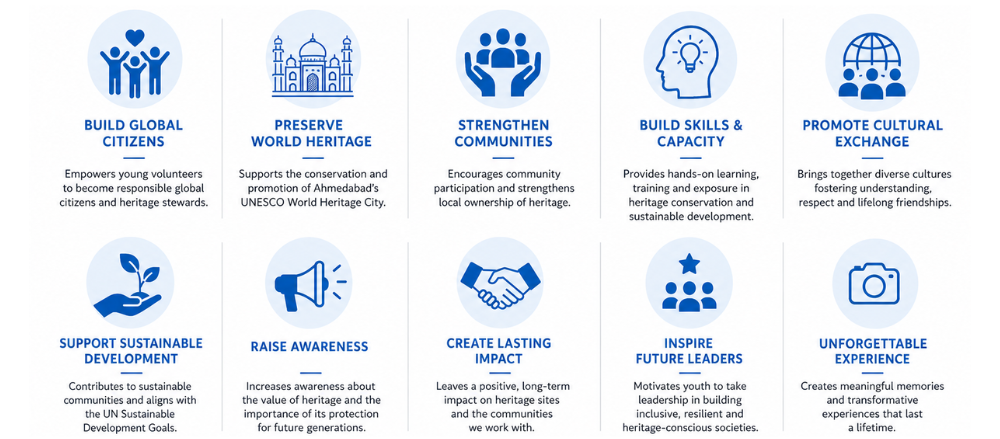
The project aims to promote heritage conservation and preservation among young people. To raise awareness among local communities on conserving and promoting the heritage site. To engage volunteers in hands-on learning experiences in collaboration with local site managers. To sensitise young people about site ownership, responsibility, and sustainable conservation practices. To build a strong network of local and international volunteers and take the heritage narrative to a global platform. To design and launch on-site awareness and engagement campaigns. To facilitate connections between local communities and relevant authorities for effective site management and conservation. To carry out cleanliness drives and support restoration-related activities at the heritage site. To prepare a concise program document capturing activities, learnings, and outcomes.

Eligibility Criteria

  • Participants must be between 16 and 35 years of age.
  • Participants must be available to attend and actively participate for the entire duration of the program.
  • Participants should demonstrate a keen interest in heritage conservation, community engagement, and the promotion of World Heritage Sites.

Eligible Regions
Open to participants from all regions and countries.

Program Dates
26 September – 05 October 2026

Participation Fee

The participation fee is non-refundable and covers:

  • Accommodation
  • Meals
  • Local transportation during the program
  • Program activities and materials

Fee Structure

  • INR 20,000 – Indian Nationals
  • USD 350 – International Participants

Please Note:
Participants are responsible for arranging and covering the cost of their travel to and from the World Heritage Volunteers project site (Ahmedabad City).

Author

ElixirFoundation